
Data is important.
As physicians, we strive to practice evidence-based medicine, and that relies on data. In my own life, I try to use data to guide my behavior and habits.
That is why heart rate variability (HRV) has been so interesting to me.
I’m not the only one. The fitness wearable industry is desperately looking to expand its market beyond the hardcore athletes, and we regular folk are the target. Enter HRV, and the claim that, by using it, we can know just how stressed, relaxed, and recovered we are.
After all, wouldn’t knowing how ready our body is, each moment of the day, make our lives so much better?
That’s the promise, at least. But the more I have looked into it, the more I think we are being sold something they can’t deliver.
First, we need to understand what heart rate variability is. Simply put, it is the slight variation in the time between heartbeats. This variation is small, on the order of milliseconds, and is a reliable marker of our autonomic nervous system activity.
Higher heart rate variability is better, and there is data that links regularly low HRV with worse overall health.
And… that’s pretty much it.
Which is why we are being sold a false bill of goods.
Let’s look at what all of these consumer devices are actually measuring. HRV can only really be determined from an electrocardiogram (ECG). What all of these devices we wear on our wrists, fingers, or chests are measuring is actually pulse rate variability (PRV). And while this approximates HRV, it is not the same and is less accurate.
So we are already starting out on shaky ground.
But the claims are where things really fall apart. Every company or application has its own score: Readiness, Recovery, Battery, Stress. All are the same basic thing: a number, generated by a closed and private algorithm, that somehow combines your HRV, sleep time, and some other vitals to suggest how ready your body is each day, with HRV carrying the most weight per some reports.
And all of these scores serve one purpose: to convince you to buy their device and pay for their service so you can optimize your life.
There are so many shortcomings in this approach. To start with, HRV is primarily influenced by age, with a decline over time beginning in our 20s. Our genetics play into it as well. Those two largest influences are completely out of our control, so plans to optimize fly right out the window.
Other factors influence HRV as well: activity, nicotine, alcohol, movement, body position during measurements, and even talking and changing our breathing rate.
If checked during the night, while mostly still, breathing steadily, and lying down, the measurements will be more accurate. However, during the day, as we move and talk, the accuracy of HRV as a marker of our autonomic nervous system decreases to the point of being meaningless.
Furthermore, studies have shown that overnight HRV was not impacted at all by the previous day’s perceived mental or emotional stress. And efforts to increase HRV haven’t shown improvements in longevity or other health outcomes.
In short: yes, it is a real measurement, but it means much less than we have been told.
I’ve been measuring HRV for a couple of years now. It all started with a mattress pad (from 8 Sleep) that reports it every morning. And for the past year, I have been using Athlytic, an app that uses the data from my Apple Watch to give me more data than Apple Health has provided.
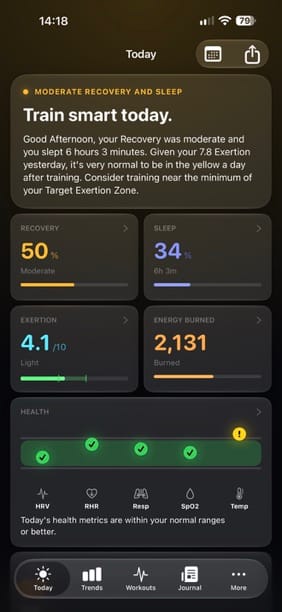
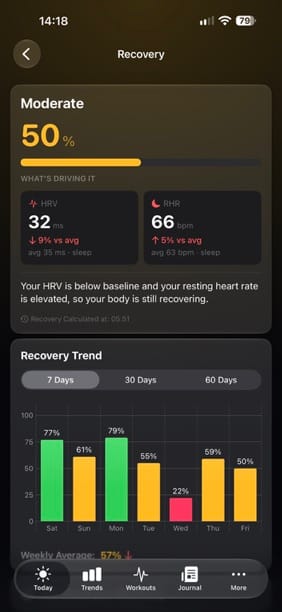
And while I think they made a very nice, interesting application, it has been entirely useless for me.
On days when it has my recovery at 100%, I never feel any difference. And when it has told me my recovery was very low and I need to take it easy, I have never felt particularly worse off.
In fact, the only times I have ever looked at a low recovery score and thought, “yep, that looks about right,” have been on days when I—due to work—got less than 4 hours of sleep.
I didn’t need any app to tell me I was going to feel crappy on those days.
The problem runs deeper than just this lack of relationship between our HRV and actual daily readiness.
Humanmaxxing continues to be huge online. We are assaulted daily by people telling us to optimize and how to do it. We need to movement-max, fiber-max, water-max, electrolyte-max, sleep-max, and optimize our HRV.
The message is clear: whatever we are doing, we are doing it wrong. Heck, I’d be tempted to say our HRV is bad because we are too stressed about optimizing our HRV if we didn’t already have data to debunk that.
The truth is we aren’t broken. We don’t need to be fixed. Optimization is pretty good for some workflows. It isn’t good for something as messy and complicated as life. Too many variables, too many influences—internal and external—for optimization to do anything meaningful.
Other than convincing us we are broken.
Are there things we can do to improve our health? Of course. Find ways to improve your sleep. Move more. Move heavy things from one place to another. Eat fruits and vegetables, enough protein, and not too many snacks and sweets.
But don’t worry about the small stuff. And it is mostly small stuff.
HRV? Yeah, looks great on the screen. Means almost nothing for your day. Don’t beat yourself up over it. Won’t help anyway.