
I’ve recently been trying to improve/change how I approach the newsletter. Part of this is for my own sanity. One of the changes I've made is to come up with a rotating schedule of types of articles.
One of those types of articles is what I'm simply calling “Experiments”. It gives me the opportunity to write about any number of things that I am trying. Some months, it may be an experiment I'm planning to do. Others, it may be an experiment that I've already run. I expect these articles will be looser in nature, as they are an amalgamation of my thoughts about the experiment itself and how it went (if this is at the end of doing an experiment).
Disclaimer: This post is about the use of AI tools. I know that there are those who dislike the use of AI, and I respect that. Feel free not to read.
I have a long and somewhat complicated relationship with journaling. I've written about it before, but as a child, it was always something I was told I should do, but I never really understood it.
Every January 1st, while making resolutions, I would resolve to journal. Again. I would start writing; it would last for a few weeks, maybe a month or two, but it always ended. I didn’t continue because I didn’t see benefit in my teenage ramblings.
As an adult, I have found it to be increasingly beneficial. I find it an excellent way to reflect on my day, my thoughts, and process what happened. It helps me be more conscious of my own actions.
At the same time, I admit that I'm not as consistent with it as I would like to be. I tend to do it in fits and spurts. Recently, I was introduced to a journaling app simply titled stoic.. It is a combination journaling and reflection app based on principles of Stoicism that includes the option of AI prompts to enhance the journaling experience.
I gave it a try. I used it one night, and I found that the prompts to “go deeper” were helpful. I was intrigued and thought that I would start using it. Then, after looking at the $99/year price, I realized I was already paying for tools that would provide a similar experience. All I had to do was set that experience up.
And so I decided to experiment.
I have journaled for a number of years using the app Day One.
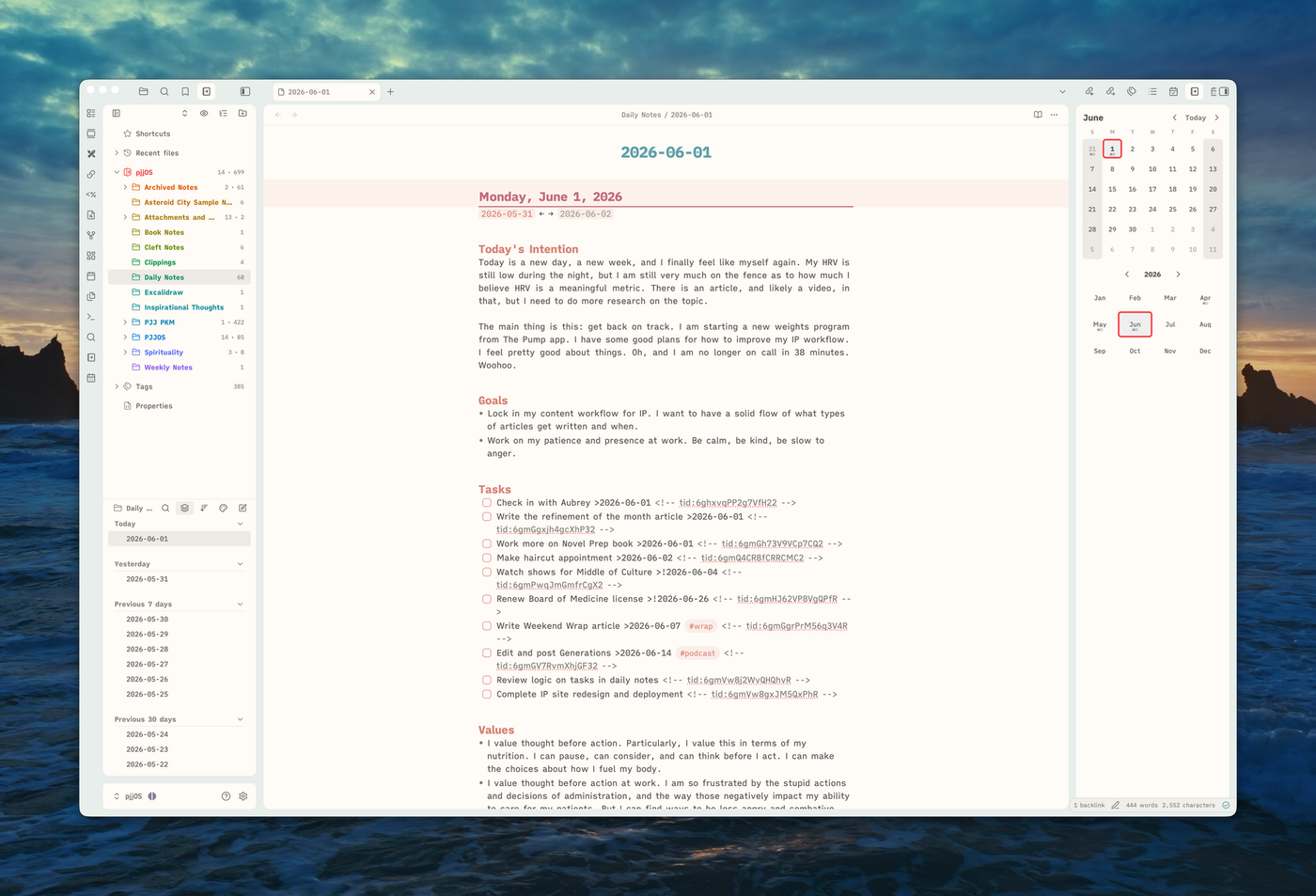
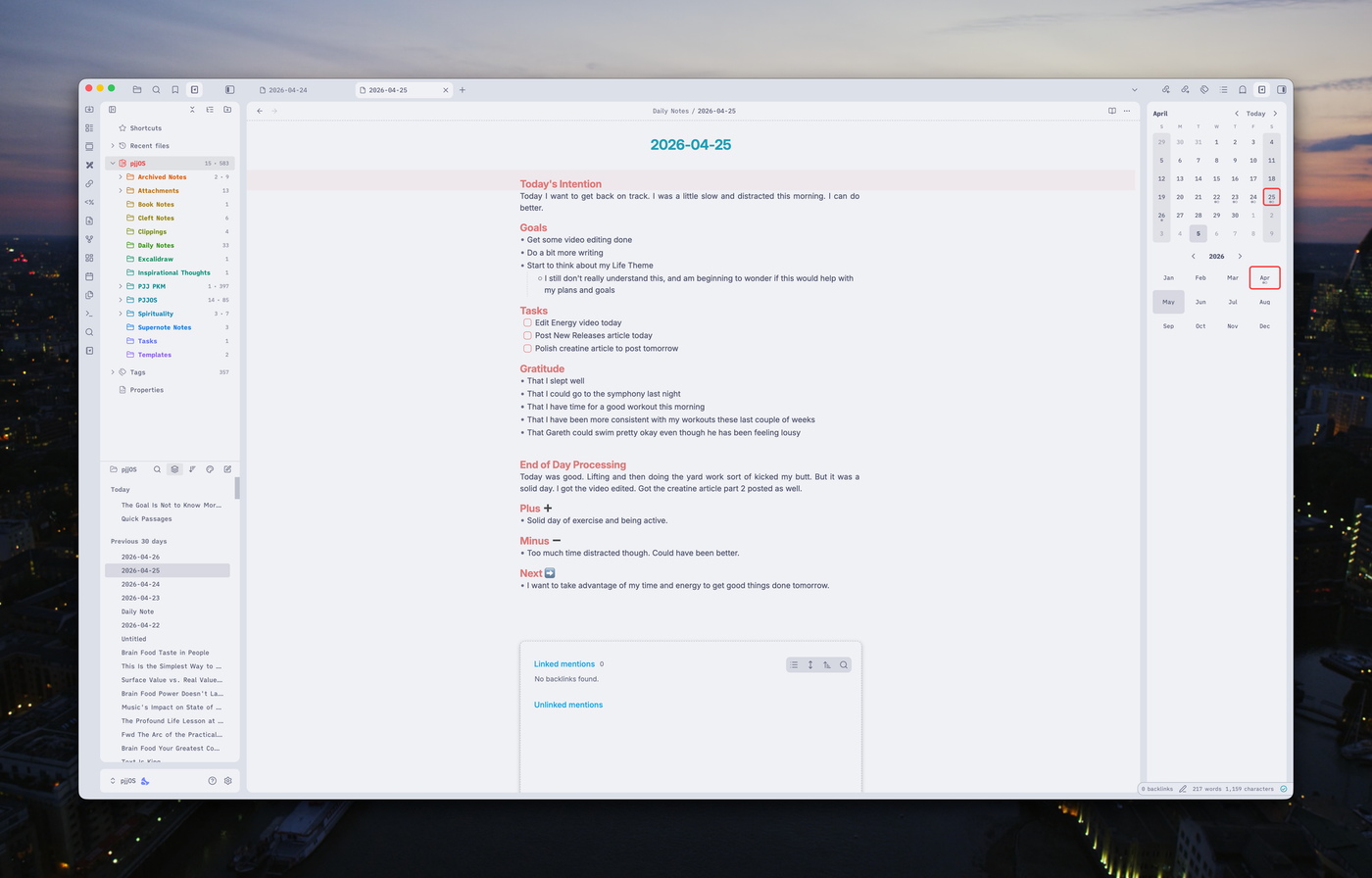
It is a well-made, attractive, and user-friendly journaling tool. I've experimented with other tools, such as using a daily note in Obsidian, NotePlan, and the built-in Apple Journal app, but I keep finding myself coming back to Day One. It is the most pleasant experience I have found.
Here comes the AI portion.
With the continuing evolution of AI tools, Day One has released an MCP server. For those who aren't familiar, an MCP, or Model Context Protocol, is a system whereby AI tools can talk to other applications, interacting with them based on the rules of the server.
I set up the Day One MCP server and explained to Claude what I wanted to do. I told it what the experience was using the stoic. journaling app, and asked it to both replicate that workflow and adjust it in a few ways where I felt that stoic. didn't serve my personal needs.
And then I used it.
The process was simple. I sat down at night, opened Claude, and dictated about my day. Based on what I had dictated, Claude would ask me a question prompting further reflection about something I had just said. It would do that two or three times, and then offer to continue or close that thread.
Once I had closed a thread, it would either ask a question about something else I had said or ask me if there was anything else that I wanted to reflect on. It didn't offer any feedback, per my instructions. That wasn’t something I wanted. I wanted mild suggestions to deepen my thoughts about the day.
At the end of that, Claude would write an entry into Day One. My words were entered exactly as I had said them, with Claude’s questions in italics to keep them separate. There was no editorializing or altering of what I had said.
I enjoyed it. I found that it helped me reflect more deeply about my day. It gave me time to reflect more on my experiences and thoughts.
And after 2 1/2 weeks, I stopped.
I stopped not because it wasn't a good experience. I stopped because I wanted my journaling experience to be just that: my experience.
I recognize that none of these AI tools have thoughts. They are probability machines that take input, convert it to tokens, and then regurgitate back the most probable response based on all of the data used to create and train the model. So there is no thought, there is no soul, and there is no actual intent in the response from the AI.
And for reasons I cannot fully explain, that began to feel like something that I did not want in my reflective, personal journaling time.
While I know there are those who abhor modern AI tools, I find them to be both interesting technologies I want to understand and quite capable of being useful with many of the repetitive, mundane tasks in my daily life.
I think that these companies need to be better. I think that they need to do better, but I think that the tool is just that: a tool to be used by people. And to be used thoughtfully and intentionally.
But given the deeply personal nature of journaling, after experimenting, I decided I wanted that to be just for me.
I'm glad I did the experiment. If nothing else, it provided a model for me to be more reflective on my own when journaling. The experience of having the tool ask me if there was anything I wanted to go deeper with trained that muscle. It is now something that I find easier to do for myself.
While it was a fairly short-lived experiment, it has improved and influenced my ongoing journaling practice.
That's why I so enjoyed the book Tiny Experiments and continue to think about how to apply it to my life. I think that being willing to experiment with ourselves, what we're doing and how we do it, helps us learn more about ourselves and the world around us. I think that improves our ability to interact with people, help those around us, and be better members of a society.
Do I plan to introduce AI into my journaling again in the future? No, I do not, but the experiment has changed how I approach the practice in general, and for that, I am grateful.