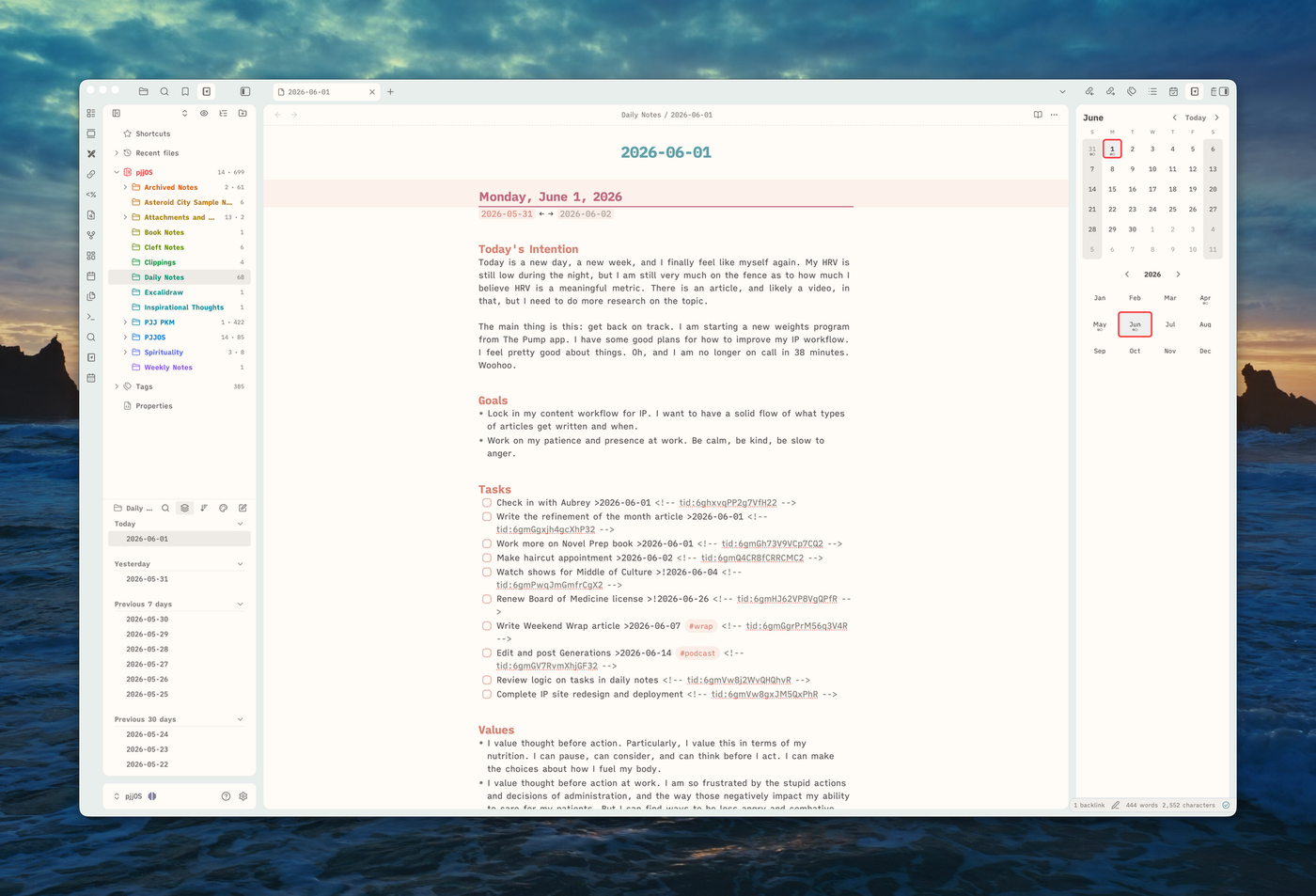

Journaling is an extremely personal activity. There are a host of different ways to go about it, with different focuses, different types of journaling, and almost too many tools to count.
For me, at least, it is also an exercise in evolution.
Over the years, I have avoided it, embraced it, and gone about it various ways. Recently, I wrote about my experiment journaling with AI. And while it wasn’t ultimately for me (due to the highly personal nature of journaling), it was an experiment I was glad I did, as it enhanced my practice in a few different ways.
Shortly after publishing that, I was contacted by a representative behind the journaling app Daymint. And, since I enjoy trying tools, decided to give it a try.
What is Daymint?
At its heart, Daymint focuses on getting the words on the page with as little friction as possible. I appreciate that. Often people are reluctant to start journaling because they don’t know what to write or feel too much pressure to make it perfect.
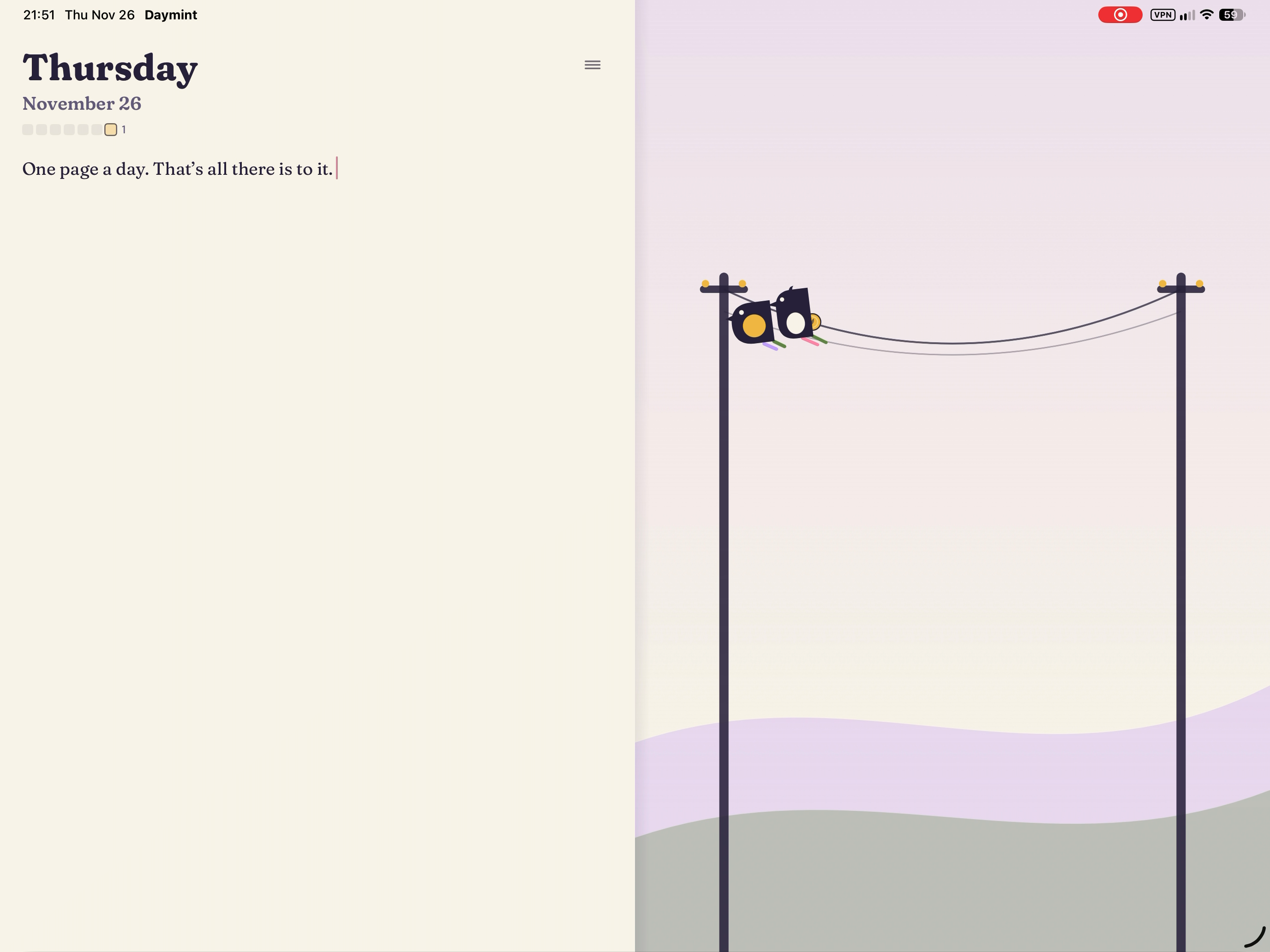
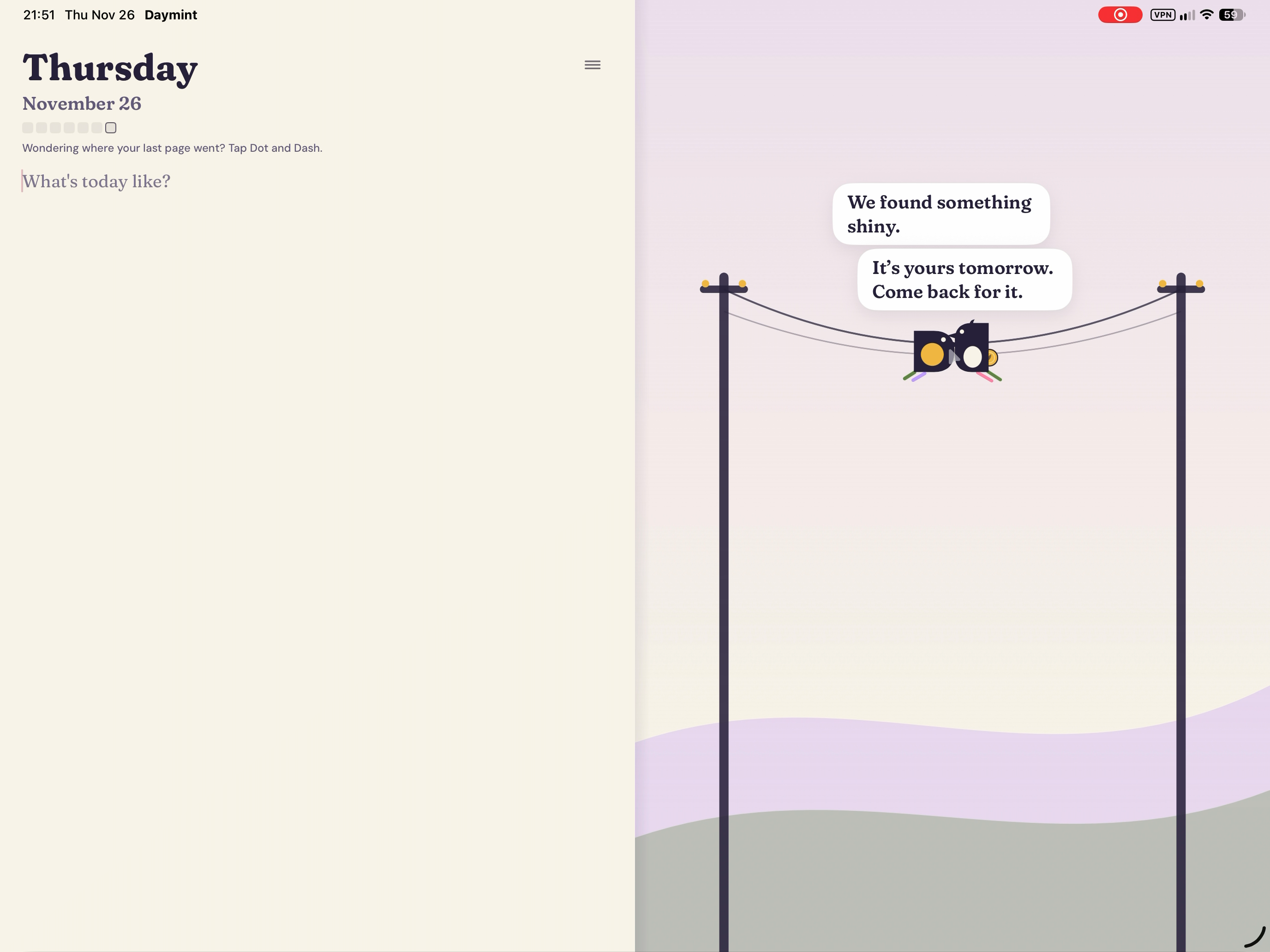
Daymint tries to eliminate those concerns in an interesting way. When you open the app, all you have is the blank page for today. You can write as much or as little as you want. It is there all day, ready to add to at any time. Once midnight hits, the page is “minted”, turned into a coin, and taken off by two bird mascots, Dot and Dash.
You can’t go back to a previous entry. Periodically, past entries will be surfaced, but you have little control over that. And that’s pretty much it.
The Experience of Using Daymint
The app is well made. It is pleasant to use, and I appreciate the ease of just sitting down and writing. Dot and Dash are cute, though I found their random movements a little distracting. And I enjoy the focus on getting words on the page. It is available on both the iPhone and the iPad, and data can sync between devices.
In her book The Artist’s Way, Julia Cameron talks about the importance of “morning pages”. She prescribes writing three pages every day, zero judgment, almost a stream-of-consciousness type of writing. She emphasizes that writing daily without reservations is one of the keys to unlocking one’s creativity.
The approach Daymint takes is an effective way to encourage that type of censor- and edit-free writing.
Ultimately, though, the Daymint approach didn’t meet my needs. Journaling, for me, is much more than just getting words out, and I have plenty of tools for that. Journaling is a way to process my day, yes. But I also use those journal entries in my weekly, monthly, and quarterly planning. Being able to go back to them, to refer to previous entries, is one of the primary reasons I journal.
Not having control over that, not being able to refer back to those entries, made journaling much less useful. Additionally, only having it on the iPhone and iPad prevented me from seriously committing to it. I do most of my planning—and hence my journaling—while using a computer.
Finally, while I appreciate the app’s clean and attractive presentation, I have one concern that would prevent me from using it seriously: no end-to-end encryption.
Given just how personal journaling can be, especially when done sincerely, I was very uncomfortable with the idea that my personal journaling entries were being stored on their servers, for anyone who has access to them to see at their will, completely out of my control.
Daymint is honest and open about this, which I appreciate. The fact that your entries are visible to them is on their privacy page. I will give them credit for that.
However, with no local storage option, and making cloud sync through their service the default with no alternative and no encryption is a deal-breaker in my opinion. After only two entries, I was intensely uncomfortable doing any real writing, knowing that my data was there in the open.
We are asked to make sacrifices with our privacy regularly in our modern world. Every sacrifice requires us to make a calculation of whether the loss of privacy is worth what we are getting in return. Unfortunately, when it comes to journaling—the most personal type of writing I can think of—I just can’t make that math work. There are too many other options that either offer the user complete control of their data or an encrypted sync option to justify using an app that lacks both.
I’m glad I tried Daymint. While it isn’t something I plan to use again, there is promise there. If they offered end-to-end encryption as the default, I would be comfortable recommending it as an option for some people. I expressed my concerns about the lack of encryption to the person who had initially reached out to me. I hope they take it to heart. I would make their product significantly better.
Wrap-up
Journaling is a simple, accessible way to process one’s thoughts, emotions, and experiences. Writing is an excellent way to clarify thoughts and one of the ways we can come to understand how we think about things.
I encourage people to try it. It continues to be an important part of my days and weeks. All it takes is a piece of paper and a pen/pencil, or a simple app that will let you write. The barrier to entry couldn’t be lower, but once you dedicate some time to it, you can begin to uncover the benefits.