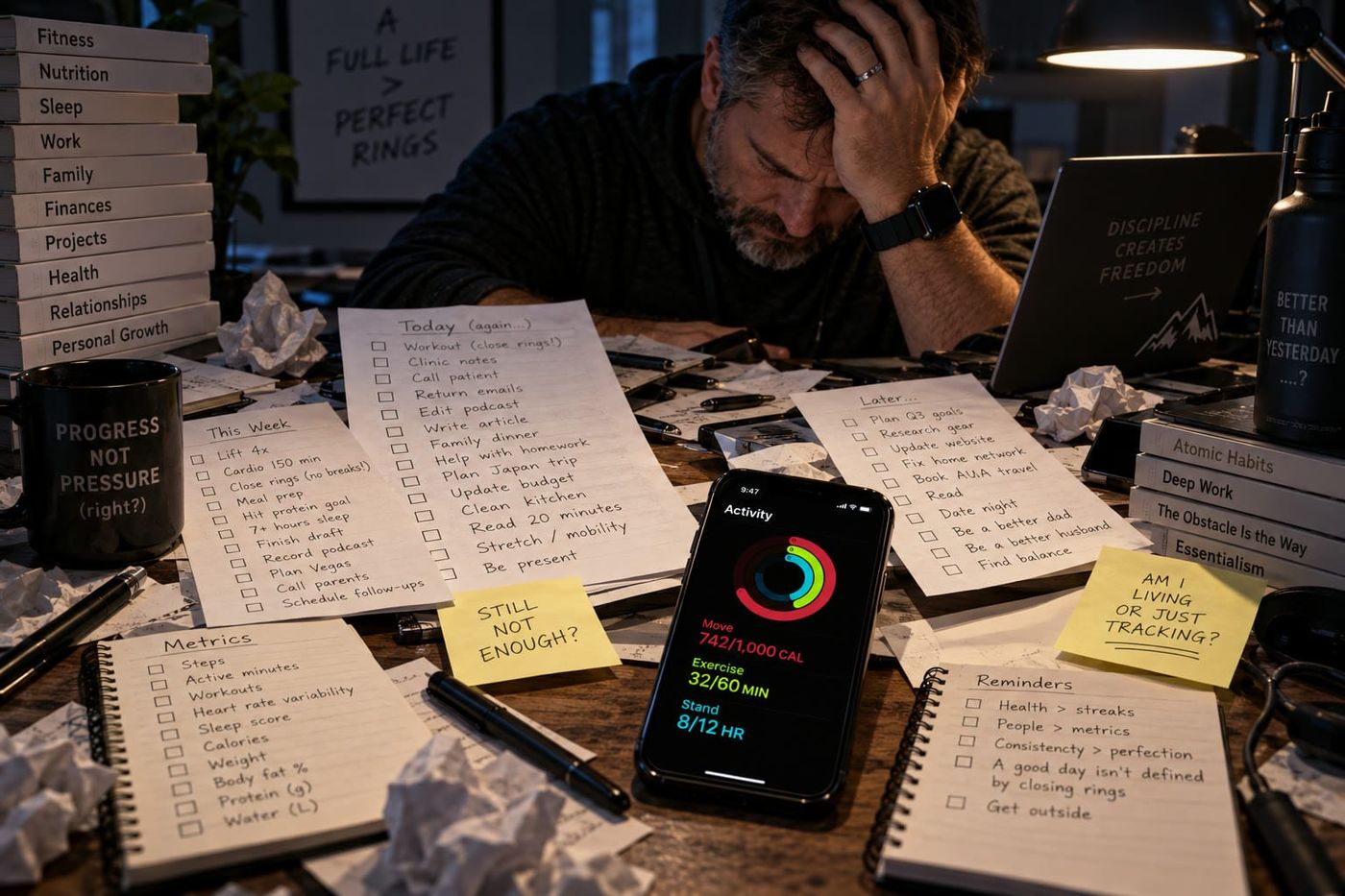

Rabbit holes.
We all fall down them. Falling and falling and falling. And if we finally hit the bottom, what do we find?
Rarely what we had hoped for.
Lately, I have been trying to claw my way back out of that hole. The hole in question?
Relentless self-optimization.
I am not the most optimized person in the world. Far from it. Too far, if I am being honest. Perhaps that has been the impetus, the drive to seek optimization. I know I need to do better. To be better.
So I have sought quantifiable ways to make that happen.
Enter “the quantified self,” a series of systems, tools, applications, and trackers to help us identify all of our many flaws, and then change them. Because, of course, as has been said many times:
You cannot improve what you cannot measure.
- Peter Drucker (and many others with other variations)
Therefore, the solution seems simple: track everything in our lives, and then begin the unending process of improving all of it. And then tracking the improvement to improve the improvement to then track…
Despite all the fervor over tracking everything, it isn’t difficult to see that, as the Bard said through King Lear’s words:
O that way madness lies.
-William Shakespeare
Optimization is a trap. It sucks us in, convincing us that in it we will find happiness, peace, the ultimate panacea for all that we face.
But it won’t. It can’t.
It is, rather, a hamster wheel, spinning and spinning. Yet never actually moving. Making no progress. Fooling us, wearing us out. And in the end, we have exhausted ourselves, spent our energy, and lost our time to an endless pursuit that left us exactly where we started.
When I began Imperfect Practice, it was a creative outlet, but one that was focused on productivity, self-improvement, and learning and trying new workflows. To be honest, right now, I can’t help but wonder if any of that is even worth the effort.
Not the creative part. In fact, over the past year, I have come to believe that having some type of creative outlet is incredibly important. For all of us. It can take on many different forms, but is still an important, and I would say essential, part of the human experience.
But regarding self-improvement, I have come to believe that much of what we have been told and sold over the years is a load of bollocks. And there is plenty of it. Just peruse the self-help section of any bookstore (if you can find one anymore), and the shelves are overloaded with missives and manuals that promise they will fix your life.
And therein lies the problem: so that we give them our time and money, we must believe that our lives are broken.
Modern self-help contains an in-built flaw: To continually improve yourself, you must continually locate the ways you are broken. (Tim Ferriss)
While promising to help us become better with an open hand, self-help has a closed fist hidden behind its back, ready to remind us that—regardless of the progress we make—we are still not enough. And we can never be enough. For if we arrive, we won’t need to buy the next book, course, or gadget to track ourselves. This is the dark heart lying at the center. We must continously believe that we are broken and need fixing.
And that is hopeless.
But that hopelessness, that unending hamster wheel isn’t the only problem with relentless optimization of the self. It also demands a dangerous assumption.
It assumes, and requires, that we no longer act as humans, but rather machines. Machines to be reprogrammed.
This should go without saying, but it bears repeating: you and I are human beings, not machines. We are created, not manufactured. We are not “wired” in a certain way. There is no code in our veins. The heart cannot be hacked any more than the mind can be downloaded. These metaphors can be useful, but when we default to them, we risk enshrining productivity as the be-all and end-all of human existence.
Machines act on programs. Set instructions. Even the AI tools that seem so impressive or odious—take your pick—are simply probability machines, predicting based on a series of rules and weights. They can be optimized, for they have no true volition, no creative spark, no emotion.
Ah, but us! We have emotions! We create! We act in ways that defy logic. And it is that randomness, that creativity, that unknown and unknowable essence of being human that makes optimization such a fool’s errand. Entropy simply insists that we can never reach peak improvement. It will ever evade and elude, always out of reach.
So why bother, right? YOLO, after all.
But we should bother. We should improve. I think the answer lies in two key things: our goals and our motivation.
Optimization shouldn’t be the target. Because it is simply an unobtainable one, a target we can chase and chase, but never achieve. Rather, we need to understand the Buddhist concept of radical acceptance.
We must accept we will fail. We will fall short. Accept it now, for it will happen. Yet, if we have already accepted it, we can plan for how to deal with it, at least in broad strokes. We can plan how we will pick ourselves up and keep trying. The failure lands much softer if it was anticipated and expected.
And when we do pick ourselves back up, we continue to work for good. Not perfect, but sufficient. That is a target that can be hit, and once achieved, can be moved forward a little. We need to be maximizers, rather we can become satisficers.
We can recognize that there is more we could do, but still accept—and be happy with—where we are, what we are doing, and the progress we have made. Even if there is more to make.
The target is reasonable and reachable.
And then there is the reason. The motivation. What is the true purpose of our efforts to do better, to be better? Self-help, self-optimization, is inherently an isolated endeavor. We hack our hormones, optimize our REM sleep, log our meditation minutes, all alone.
But we don’t live isolated from one another. We are part of a society, wherever we may be. And often we are part of multiple. We interact with, live with, and work with other people. That is the key: become better people not for our own benefit, but to be better members of the societies in which we exist.
Once that becomes the center, the improvement takes on a vastly different character.
We find ways to be better spouses, parents, partners, friends, and more. We learn how we can fill those roles in our lives more fully. We take those steps (hopefully), make the needed changes.
And become better versions of ourselves.
Not because some app or algorithm told us what to change. Not because we made our metrics “better”.
Because we love and care for other people. We strive to be better for them. We cast off the self-centered endeavor of individual optimization, and use our energy to make the world we inhabit a little better.
Small improvements, done by many, have an outsized effect. All of the energy expended in self-optimization helps exactly one person: ourselves.
But accepting our place as members of a society, and spending energy to improve those parts of it we touch? It helps more people than we will ever know or be able to count.
So, yes, improving ourselves is a worthwhile goal. But I would ask us to look at the why, and be willing to practice radical acceptance. The world becomes just a tiny bit better, and we will be immeasurably more joyful.