So What does Creatine do?
That's the question. How does it help? And why does that matter, even if you aren’t looking for benefits in the gym? It is so important to understand if you want to understand why I believe everyone (who doesn't have an actual medical contraindication) should be taking it daily.
It's All About Energy
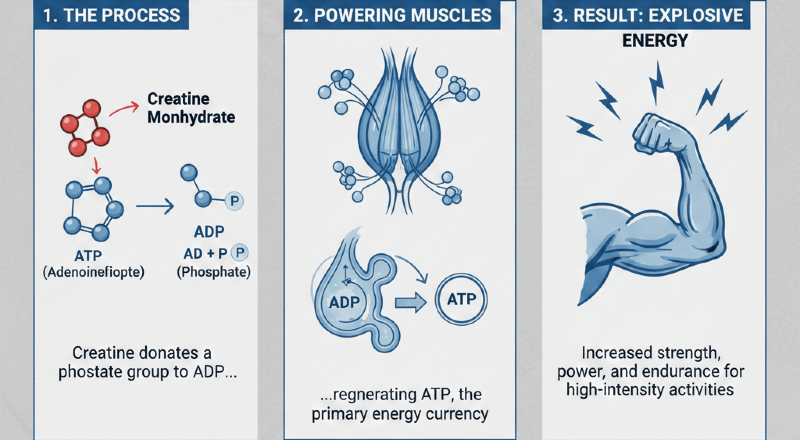
Creatine is readily absorbed and then moves quickly into cells, be they muscle, brain, etc. Once in the cells, it is converted to phosphocreatine. This is a polar molecule that doesn’t move back out of the cell, so it accumulates in those cells until it is needed.
Once it is inside the cells, that is where the magic happens. Phosphocreatine, like ATP, has a phosphate group on it that it very happily, and very, very rapidly donates to an adenosine molecule to make more ATP. This bypasses the entire cellular respiration pathway (glycolysis, the Krebs cycle, and the electron transport chain) and allows your muscle and brain cells to make more ATP extremely quickly and efficiently.
This means more energy when you need it, and almost instantly.
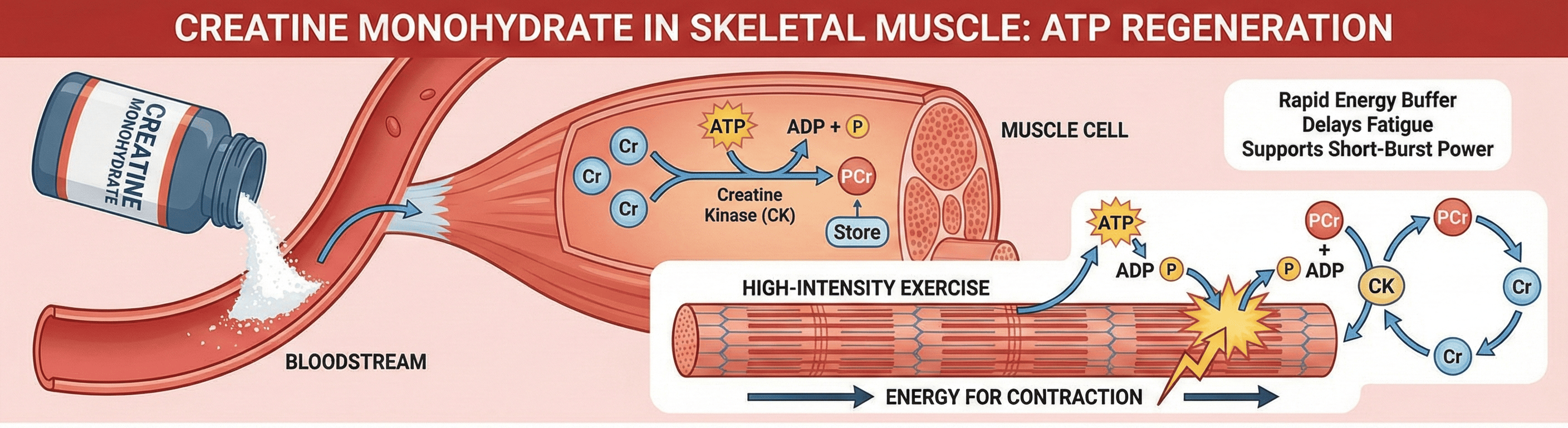
In muscle cells, this means you have a ready and full pool (if you have been supplementing) of energy when your muscles need it. When lifting weights, it allows for more explosive power and more reps performed. It provides a fast, efficient, and effective way to quickly generate more ATP when it is needed.
In cardio or endurance activities, it helps in many ways as well. It can increase your lactate threshold (meaning it buffers cells by using hydrogen ions, limiting lactic acid buildup), improve your muscles' ability to store glycogen (a source of energy when your glucose is all used up), and increase muscle hydration, which can help with heat tolerance.
These are all reasons why anyone who is active should be supplementing.
It has also been reported for decades.
But there is new and emerging evidence of other benefits of creatine that make it, in my opinion, an absolute must-have for everyone, regardless of whether you want the athletic performance improvements it provides.
And those are the reasons behind this series of articles.
It is this additional benefit that has been honestly life-changing for me.
Your Biggest Energy Sink... It's Not What You Think
Our brains are energy hogs.
Really. Egregious, inappropriate, selfish energy hogs. The brain is generally around 2% of your total body mass. Yet despite that, the brain’s energy use accounts for 20% of your daily basal metabolic expenditure.
That’s impressive. Pound for pound, nothing in our bodies uses as much energy as our brains.
It also raises some interesting questions. And while these questions haven’t been fully or inconclusively answered, there are plenty of signs that energy imbalances in the brain are part of the pathology of some of the most devastating afflictions.
ATP Generation and Dementia
Okay, I hope this next part isn't boring. But it is important. We talk about evidence-based medicine: Well, it needs to apply here, too. I don't want anyone to think I am making this up. Here is (some of) the data.
Findings from the National Health and Nutrition Examination Survey (NHANES) demonstrated a positive correlation between reported dietary creatine levels and WAIS III DSS. This is a marker of cognitive function, with higher levels associated with improved cognitive function. So, more creatine in the diet=improved cognition.
There have been many studies looking at higher creatine levels and their relationship with Alzheimer’s dementia. The most promising recent study was an 8-week pilot study in 2025 from Smith et al titled The Creatine for Alzheimer’s Disease and Brain Bioenergetics Trial. In this study, they performed a controlled comparison of creatine supplementation and cognitive performance in people with Alzheimer’s.
People who supplemented with high doses of creatine (20 g/day) performed significantly better at a number of standardized cognitive trials. There was no change in cognitive performance in the control group.
And it wasn’t just a mild improvement. This was a fairly dramatic improvement.
While just a smaller pilot study, the results are incredibly encouraging, and larger, longer studies are already in the works.
There are other, smaller studies that corroborate these findings. This has led to a hypothesis that anything that inhibits the brain’s ability to generate ATP may contribute to increased risks of dementia and worsening symptoms in those already diagnosed with these diseases. This appears to apply to age-related dementia as well: not just Alzheimer's.
And it makes sense.
One of the very common issues we see as people age is a significant worsening of their nutrition, particularly of creatine-rich foods.
Supplementation is an easy, well-tolerated, and cost-effective way to counter this. But dementia is far from the only mental benefit to supplementing.
Creatine and Mental Performance
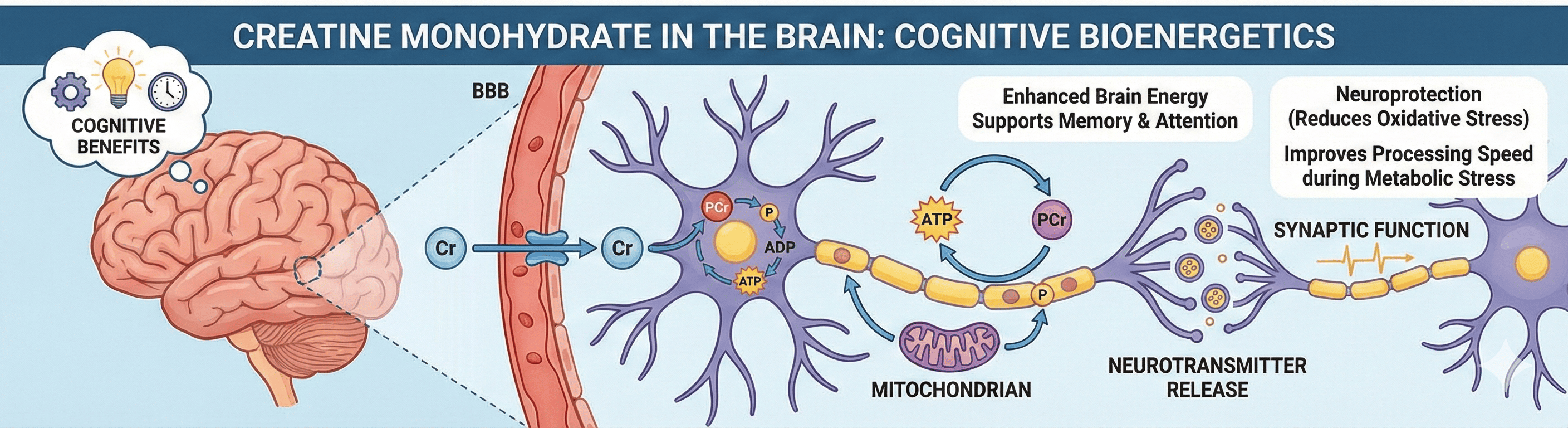
Numerous studies have examined the cognitive benefits of creatine supplementation outside of dementia domains. And while not all studies demonstrated benefit in every aspect, there are some areas where creatine supplementation has been shown, in many studies, to have benefit.
Near-infrared spectroscopy demonstrated higher levels of oxygenated hemoglobin in people performing a long series of complex mathematical calculations if they were supplementing with creatine. They performed significantly better, particularly over time, compared to those not supplementing, highlighting creatine’s ability to improve oxygen utilization and act as an energy buffer.
A 2024 meta-analysis of 16 studies looked at processing speed. Across the board, those supplementing with creatine exhibited faster mental processing than their matched counterparts. Recent studies in the world of psychiatry have found promising, early results in the reduction of depression symptoms, as well as mood stabilization, in those supplementing with creatine.
Memory, particularly short-term memory, has also been studied. The same 2024 meta-analysis found a significant positive benefit to creatine supplementation and memory function, and improvement in reasoning skills.
Finally, numerous studies have looked at creatine use in cases of sleep deprivation. The most impressive took young rugby players and forced them to perform mentally challenging tasks after different amounts of sleep. Those in the 7-9 hour group vastly outperformed those in the 3-5 hour group. However, if those in the 3-5 hour group supplemented with 25 g of creatine at least 1.5 hours before being mentally challenged, performance between the two groups was equivalent, highlighting an ability for high-dose supplementation to attenuate the negative effects of short-term sleep deprivation.
Now This is Cool
Some final biology for us to consider, because I think this part is just freaking cool.
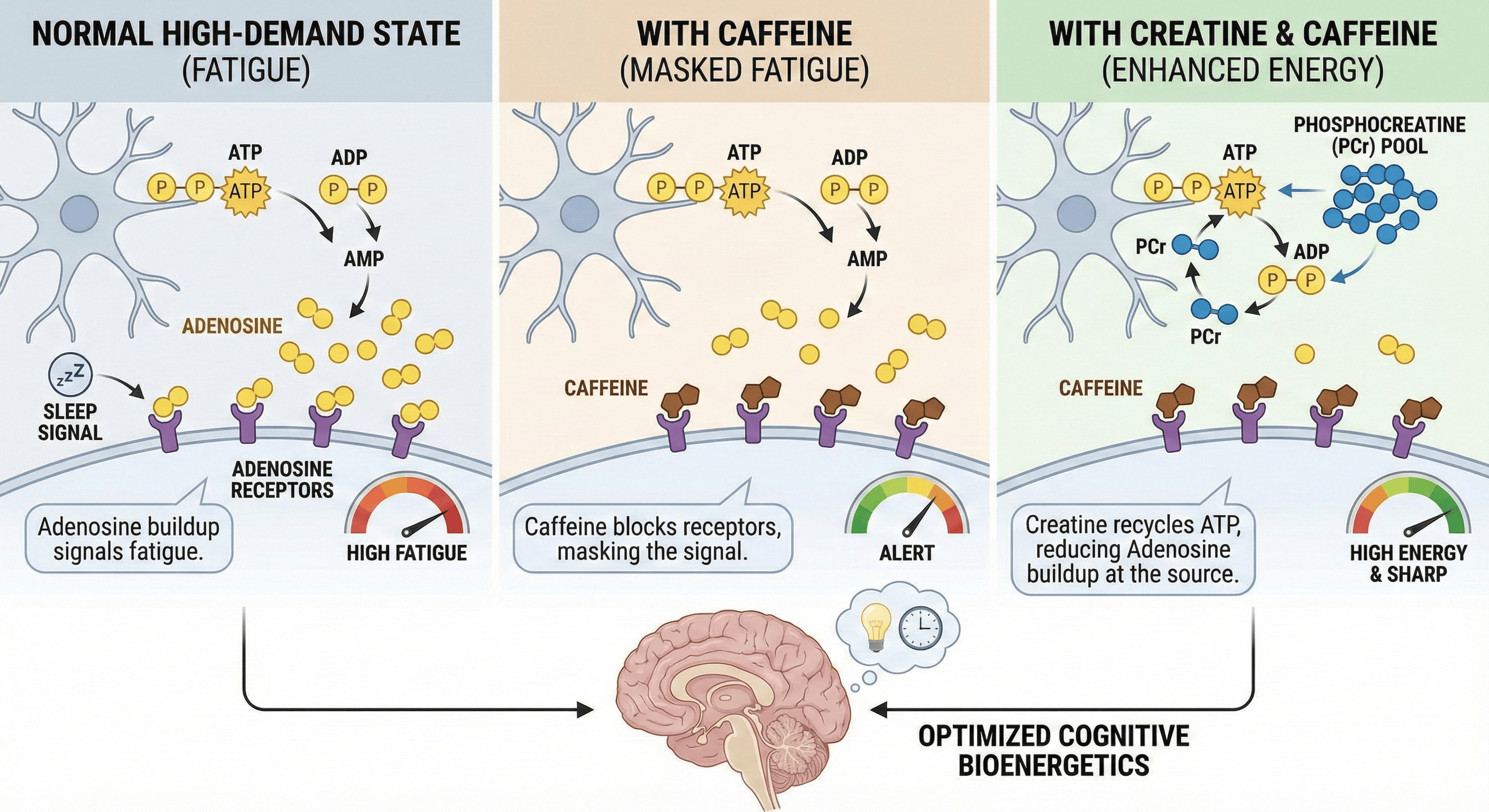
I imagine nearly all of us have reached for some caffeine when we were feeling a little tired. Ever wonder why? What does caffeine do in that situation? Again, it is all about ATP.
As we use our brain's ATP stores, and more isn't regenerated, we start to accumulate adenosine (the A part of ATP). There are receptors that bind this adenosine and are then activated. This adenosine receptor activation is a signal to your brain that you need to rest. You are tired. You need time to stop thinking and put more phosphate on that adenosine, making more ATP.
Caffeine is shaped a heck of a lot like adenosine. So much so, in fact, that your adenosine receptors and caffeine see each other and think, "Hey, I know you! Let's hook up again!" Caffeine binds to those receptors, blocking adenosine from binding. But guess what, caffeine doesn't actually activate those receptors. So that signal you are tired? Never happens. The fatigue is blocked because the signal you are running out of ATP is blunted. We feel more mentally awake. This is incredibly useful, but also a bit of a fakeout. Adenosine is still building up, and when the caffeine is broken down and out of the way, there is now extra adenosine, ready to activate those receptors.
We crash.
But what if you made much less adenosine, because there was a surplus of extra phosphocreatine, ready to turn that adenosine back into ATP? That is exactly what happens when you supersaturate your brain cells by taking high doses of creatine. High doses are needed to push it across the blood-brain barrier, but once there, it stays there until used and broken down.
Yes, high-dose creatine literally makes you less tired and more alert by limiting adenosine buildup. Coupled with caffeine? That can be a pretty powerful combination.
The studied benefits are significant and across multiple areas. And this is the key. We can all benefit from these improvements. This has nothing to do with being in the gym. This is about everyday life. This is about having more mental clarity, being more present, remembering things better, handling stress better.
I bet we can all benefit from this. But here is the key: All of the mental benefits were seen in that high-dose supplementation needed to cross the blood-brain barrier.
So if we are taking higher doses, what about safety?
Safety of Creatine Supplementation
Safety is one of the most mentioned concerns. Personally, I have had more people than I can count ask me about supplementation safety, particularly regarding kidney function.
Fortunately, this is almost entirely a misunderstanding of how we most often measure kidney function. Blood creatinine levels are the most common way to estimate kidney function (or glomerular filtration rate—GFR). Creatinine is a breakdown product of creatine, so yes, supplementing with high doses will increase blood creatinine levels.
It is important to remember, though, that creatinine levels don’t actually measure kidney function. There is a reason that the GFR on any basic metabolic blood test that has creatinine as one of its measurements is called an estimated GFR. That is just what it is: using one easily measured marker to estimate something else entirely.
The truth is, there isn’t any evidence that, in people with normal functioning kidneys, it causes any renal damage. And there are other ways to estimate GFR that aren’t influenced by creatine, allowing for accurate measurements over time, the use of which has proven no loss of kidney function with high dose supplementation over time (with some studies even looking at 30 g/day over 5 years).
Higher doses, particularly at first, can cause some gastrointestinal issues, as creatine that isn’t absorbed can pull extra water into the gut. However, creatine monohydrate is almost 100% absorbed by the intestine, and most people tolerate it without issues if they gradually increase the dose. Ensuring the creatine is fully dissolved alleviates this issue almost completely.
Creatine supplementation works.
And it is absolutely safe.
What Next?
I put this together quicker than I planned after people expressed interest in knowing more. I hope this has been helpful.
But studies in journals only mean so much. What about the real world?
That will be the final article in this trio: my personal experiences with both supplementing and (unintentionally) stopping supplementation. That will be coming in the next few days. I hope you can tell this excites me, and I'll soon share exactly why.